How Games Work

Articles

Each article takes one part of how a game works and explains it with a game you can buy today. Filter by topic, or sort by title, complexity or how much chance is involved.

List of articles

Topic

4 articles.

How Ticket to Ride keeps its rules to a few pages

long entry, rules; example: Ticket to Ride (Days of Wonder)
Complexity
1/3
Role of chance
2/3
Reading time
About 4 minutes
Rules checked
27 November 2026
Three cream cards with ink drawings of a card stack, a line between two dots and a ticket, under a paper strip reading Rules on a few pages

Ticket to Ride is often the first game people buy after the family classics, and its rulebook is part of the reason. The 2025 rulebook from Days of Wonder covers a full game in a few pages, with room to spare for pictures. The rules are short because a turn is short: one choice out of three, every time.

One turn, three choices

On your turn you do exactly one of these, and the list never changes from the first turn to the last.

  • Take train cards. You take two, from the five face-up cards or blind from the deck. A face-up locomotive is the exception: take one and it is your only card that turn.
  • Claim a route. You play cards that match the route’s colour and length, then put your trains on it. A grey route accepts any one colour, and locomotives count as any colour.
  • Take destination tickets. You draw three and keep at least one. Each ticket names two cities you now want to connect.

Each is a single step. A new player never has to plan a chain of moves, only pick one. Judging which of the three matters most this turn takes a game or two to learn, and the rulebook leaves that to you.

The three actions in Ticket to Ride From your turn, three arrows lead to three choices: take two train cards, claim one route, or take three destination tickets and keep at least one. Your turn Take 2 train cards or 1 face-up locomotive and nothing else Claim 1 route play cards matching its colour and length Take 3 destination tickets keep at least 1
A turn in Ticket to Ride. The player picks one box and the turn is over.

An ending you can see coming

Each player has 45 trains. When someone ends a turn with two or fewer left, every player, including that one, takes one final turn. Then the game stops. This needs no extra counter or track. Look across the table and you can see who is running low.

Scoring in two parts

Points arrive at two moments. A claimed route scores at once: 1 point for a route of one, then 2, 4, 7, 10 and 15 points for a route of six. At the end, each completed ticket adds its value and each unfinished one subtracts it. The player with the longest path of connected trains also takes a 10-point bonus card.

Tickets stay until that final count. A player who looks well behind on the score track can still win, so nobody stops trying in the last few turns.

What the rulebook leaves to you

Most of the game happens in your hand. You save cards of one colour for a long route, but every turn you wait gives someone else a chance to take it. That is , and the rules never mention it. Gathering matching cards, a kind of , is the other half, and again the rulebook only says what counts as a match.

Check which printing you have

Some details change between printings. In the 2025 rulebook each player starts with four destination tickets and keeps at least two; older printings deal three. With two or three players, only one track of each double route can be used. If your box is older, follow the rulebook inside it.

Back to the list of articles

The two dice of Catan

long entry, chance; example: Catan (CATAN GmbH)

Complexity
1/3
Role of chance
3/3
Reading time
About 4 minutes
Rules checked
27 November 2026
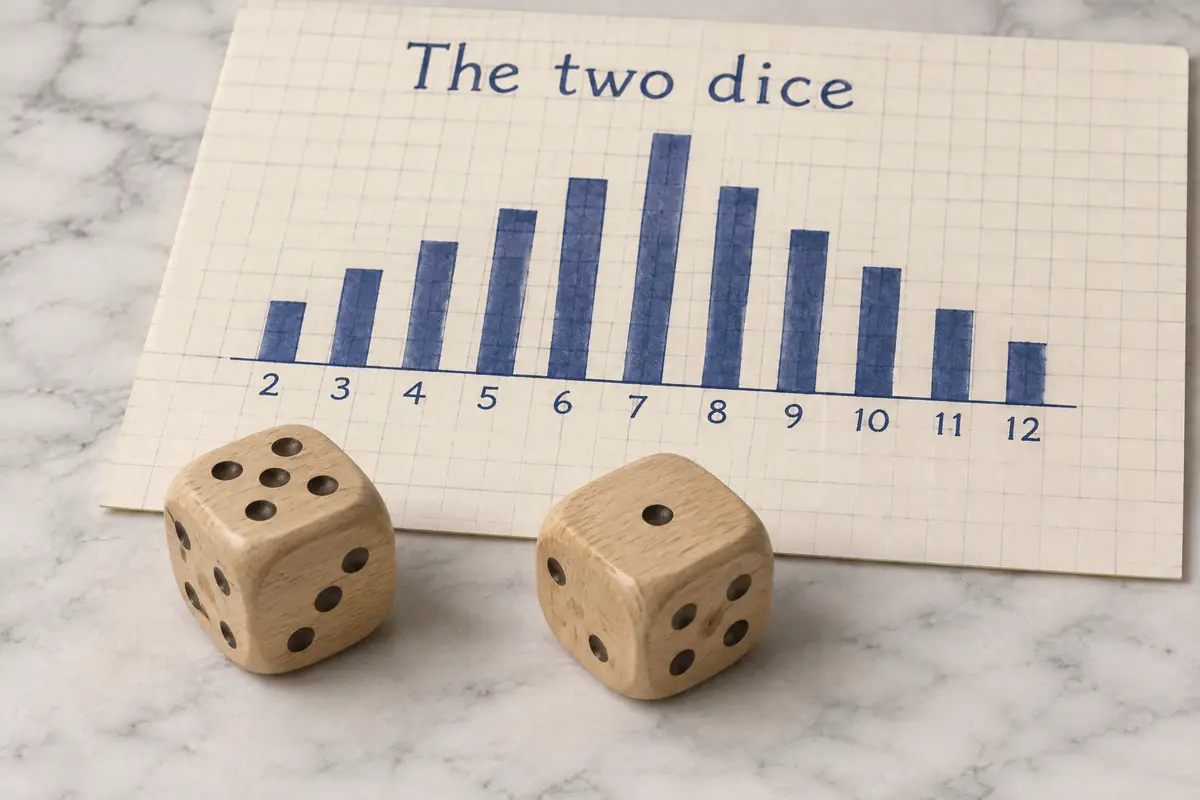
Two wooden dice in front of graph paper with a blue bar chart for totals 2 to 12 under the words The two dice

In Catan the player whose turn it is rolls two dice at the start of the turn. The total picks which hexes produce, and every settlement or city touching a hex with that number collects its resource. One roll feeds the whole table. That’s a large part of why waiting for your turn in Catan rarely feels like .

Why 7 comes up most

Two dice can land in 36 equally likely ways. Only one of them makes 2, a one and a one, and only one makes 12. Six make 7: one and six, two and five, three and four, and each of those the other way round. Totals in the middle have more ways to happen, so they happen more often.

Ways to roll each total with two dice A bar chart of the 36 ways two dice can land. Totals 2 and 12 have one way each, 3 and 11 two, 4 and 10 three, 5 and 9 four, 6 and 8 five, and 7 has six. 12 23 34 45 56 67 58 49 310 211 112 Total rolled (numbers above the bars show ways out of 36)
Out of 36 rolls, on average: a 7 six times, a 6 or an 8 five times each, a 2 or a 12 once each.

Put another way, a hex numbered 6 or 8 produces about five times in every 36 rolls. A hex numbered 2 or 12 produces about once.

The robber on a 7

The most common total produces nothing at all. On a 7, no hex pays out. Anyone holding more than seven resource cards hands back half of them, rounded down. The player who rolled then moves the robber to a new hex and takes one random card from a player with a building next to it. So the roll you’ll see most often is a small fine for hoarding and a small gift for whoever threw it.

Luck you can plan around

The dice are , but it is luck with known odds, and you see it coming. Settlements go down before anyone rolls, and the number on each hex tells you how often it should pay. Two settlements on a 6 and an 8 cover 10 of the 36 outcomes. Three settlements on a 2, a 3 and a 12 cover only 4, although they touch more hexes.

A short run is the part you can’t plan for. Over a few dozen rolls the totals can wander a long way from their averages, and a 6 can go missing for ten turns in a row. Dice have no memory, so a 6 is no more likely after a long gap than at any other time.

Winning still takes choices

You win by reaching 10 , and only on your own turn. The dice hand out materials, nothing more. Trading, deciding what to build and choosing where to send the robber all happen after the roll, and those choices separate the players far more than any single throw.

Both the 2025 sixth edition and the earlier fifth edition give the same rules for the roll, the robber and the win, so this article holds for either box.

Back to the list of articles

Building a deck in Dominion

long entry, choice; example: Dominion (Rio Grande Games)

Complexity
2/3
Role of chance
2/3
Reading time
About 5 minutes
Rules checked
27 November 2026
Plain cards with blue borders laid in a loop with arrows, around a card reading Building a deck

In Dominion every player starts with the same ten cards: seven Coppers and three Estates. Over the game you add to that pile one purchase at a time. By the end the deck is entirely your own, and so are its problems.

A turn in three letters

The Rio Grande Games rulebook calls the turn ABC: Action, Buy, Clean-up. In the Action phase you may play one Action card. In the Buy phase you lay down Treasure cards for coins and buy one card from the shared Supply. At Clean-up you discard everything you played and whatever is left in your hand, then draw five new cards. When your deck runs out, you shuffle your discard pile into a new one.

Some cards give you extra actions or extra buys. Most of the game’s variety comes from those small additions to a very plain turn.

Where a new card goes

A card you buy doesn’t go to your hand. It goes on your discard pile, waits for the next shuffle and only then turns up in a draw. Every purchase is a bet on a turn that hasn’t happened yet. Planning around that delay is most of the skill in .

Where a card travels in Dominion A loop of four places. A card bought from the Supply goes to your discard pile. When your deck runs out, the discard pile is shuffled into a new deck. You draw five cards from the deck into your hand, and at clean-up the hand and played cards go back to the discard pile. Supply Discard pile Deck Hand buy 1 card shuffle when deck is empty draw 5 clean-up
The loop every card follows. A purchase joins the loop at the discard pile, not in your hand.

The first two turns

The opening is the same for everyone and easy to work out. Your first two hands use all ten starting cards, five in each. With seven Coppers spread across them, the two hands are worth 5 and 2 coins, or 4 and 3, in one order or the other. A Silver costs 3, so a 4 and 3 opening can buy one on each turn.

Points that slow you down

Estates, Duchies and Provinces are worth 1, 3 and 6 . You need them to win. In your hand, though, they do nothing. Each one you buy will one day take the place of a Copper or an Action card in a draw of five. Buy them too early and the deck stalls; leave them too late and the Provinces are gone.

How it ends

The game ends when the Province pile is empty or when any three Supply piles are empty. Everyone then counts the points on all of their cards, and the highest total wins. The three-pile lets a player who is ahead empty cheap piles on purpose and bring the end closer.

One small rule shows how the game is meant to be played again and again: if the previous game wasn’t a tie, its winner goes last in the next one.

Back to the list of articles

Winning together, winning alone

long entry, interaction; example: Pandemic (Z-Man Games) and Carcassonne (Hans im Glück)

Complexity
2/3
Role of chance
2/3
Reading time
About 5 minutes
Rules checked
27 November 2026
Four blue wooden pawns huddled together and four pawns of different colours standing apart, under the words Winning together, winning alone

Most games end with one winner. Pandemic ends with everybody winning or everybody losing. Carcassonne keeps the usual one score per player, but those scores are tangled up in each other. Side by side, the two games show how much one rule about winning shapes the way players treat each other.

One result for the whole table

In Pandemic, from Z-Man Games, the players share a single goal: find cures for all four diseases. The moment the fourth cure is discovered, everyone wins. The diseases don’t have to be wiped out.

Losing is shared too, and it can happen three ways. The table loses on an eighth outbreak, when there aren’t enough disease cubes to place, or when the player deck runs out. On a turn, a player takes up to four actions, draws two player cards and then infects cities. The game plays against everyone, and it gets a turn after each player.

With no rival at the table, becomes planning. Players talk moves through, pass cards when the rules allow it and argue about risk. A familiar problem is one confident player directing everybody else. The rules can’t stop that; the group has to.

A score each, built on shared ground

Carcassonne comes from Hans im Glück and is published in English by Z-Man Games. Every turn has the same shape. You draw a tile and place it so its edges match the tiles beside it. Then, if you want, you put one of your meeples on a road, city or monastery on that tile, as long as nobody already holds that feature. Anything finished is scored at once.

A road scores 1 point per tile. A city scores 2 per tile and 2 more for each coat of arms. A finished monastery is worth 9: its own tile and the eight around it. Fields are scored only at the end, and in the current edition the farmer rules sit in a supplement that the rulebook suggests adding after two or three games.

Interaction here is quieter and sharper. You can’t place a meeple on a city someone already holds, but you can lay tiles so that your city joins theirs. If the meeples are tied, both players score the full points; if you have more, the points are yours alone.

How Pandemic and Carcassonne decide the result Pandemic: all players share one result, winning together when four cures are found or losing together on eight outbreaks, missing cubes or an empty player deck. Carcassonne: each player keeps a score, features can be shared, tied meeples both score, and tied players share the win. Pandemic one result for the table Win together all four diseases cured Lose together 8 outbreaks, no cubes left, or no player cards left Carcassonne one score per player Shared features tied meeples both score tied players share the win
Two ways to decide a game. Pandemic has one result for the group; Carcassonne keeps a score per player but lets features and wins be shared.

What the winning rule changes

In Pandemic, helping another player always helps you. In Carcassonne, helping another player is sometimes the price of scoring at all. Neither game needs a separate rule telling players to cooperate or compete. The way each game decides its winner does that job.

Ties follow the same logic. Carcassonne lets tied players share the win, which suits a game where cities and roads are shared as well. Pandemic needs no , because there is only ever one result.

Back to the list of articles

Please note. How Games Work explains how board and card games are built. It offers no gambling of any kind and takes no bets. We link to no betting or gaming operators. Probability here only explains published board games.

Term

Definition

Read the full entry